Blog Commenting for SEO: What a Comment Link Is Actually Worth in 2026
By Michael Carter
Filed under: SEO & Link Building
Here is the short answer, before the 2,000 words that explain it: a comment link will not move your rankings. It can still be worth an hour of your week, for reasons that have nothing to do with link equity.
Most articles on blog commenting for SEO will not tell you that. They list the same seven tips — use your real name, read the post first, do not write "Great article!" — and leave you with the impression that if you comment well enough, the links will start working. They will not. The attribute on that link decides it before your comment is even approved.
This guide covers what a comment link technically is, what Google's own documentation says about it, what forty comments actually cost you in hours, and the three situations where doing it anyway is the right call.
What blog commenting for SEO means
Blog commenting for SEO is the practice of leaving comments on other people's articles, with a link back to your own site, in the hope that the link helps you rank.
The link usually sits in one of two places. Either it is attached to your name in the comment form — the "Website" field that WordPress shows by default — or you drop it into the body of the comment itself. The first is standard. The second is what gets you deleted.
That is the whole mechanic. People have been doing blog commenting for SEO since the mid-2000s, when it genuinely worked, and the advice written then has never fully disappeared from the search results.
What changed is not that Google got stricter about blog comments. What changed is what the link is made of.
What a comment link is actually made of
This is the part other guides skip, and it decides everything else.
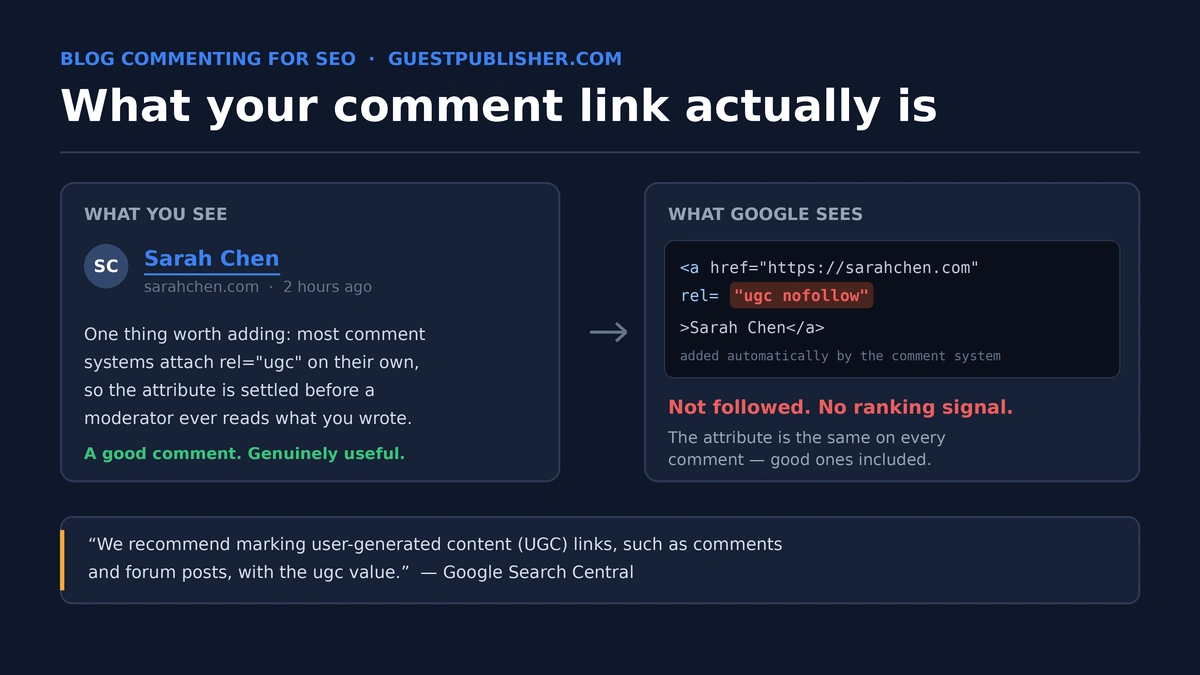
When your comment is published, the link in it does not go onto the page as a plain <a href="...">. WordPress, and nearly every other comment system, adds a rel attribute to it automatically. Google's own documentation on qualifying outbound links is explicit about which one belongs there:
"We recommend marking user-generated content (UGC) links, such as comments and forum posts, with the
ugcvalue."
So the link reads rel="ugc", or rel="nofollow" on older installs, or rel="ugc nofollow" on many. And on the same page Google states what that means in practice: links carrying these attributes "will generally not be followed" (Google Search Central).
Read that again, because it is the whole answer to the question everyone researching blog commenting for SEO is really asking. The site owner does not choose to nofollow you because your comment was poor. The comment system does it to every comment, automatically, including the thoughtful ones, including the ones the owner replies to personally. Writing a better comment does not change the attribute.
This is why nofollow blog comments are the default state of the web rather than a punishment, and why the rel ugc value exists at all: it tells Google where a link came from, not how good it is. A handful of blogs run plugins that remove the attribute after a commenter has a track record — Google's documentation even suggests it as an option for "members who have consistently contributed high-quality posts". In practice this is rare enough that you should plan as though it never happens.
So when you evaluate blog commenting for SEO, you are not evaluating a link building tactic. You are evaluating a visibility and relationship tactic that happens to leave a link behind.
Are blog comments good for SEO? Three things they do, one they do not
Taking the honest version point by point. The relationship between blog comments and SEO is real, but it runs through people rather than through PageRank.
The blog commenting benefits worth counting are these three.
They do send referral traffic. A sharp comment on a post that gets 5,000 readers a month will send you clicks for as long as that post ranks. Not many — a fraction of a percent is normal — but they arrive pre-qualified, because the person read something on your topic and then chose to click your name.
They do get you noticed by the person who matters. Every comment lands in the inbox of the site owner or editor. That is the same person who decides whether to accept a guest post from you later. Three good comments over a month is a warmer introduction than any cold email.
They do leave a trail that looks normal. A brand that appears in the comments of its own industry's blogs looks like a participant in that industry. That is not a ranking factor you can point at, but an entirely absent brand looks different from a present one to any human who checks.
They do not pass ranking signal. This is where blog comments and SEO part company. The attribute above means the link is not counted the way an editorial link is, and no amount of comment quality changes that.
If an article tells you that blog comments backlinks "still pass some juice", ask it to explain the attribute. It will not be able to, because blog comments backlinks and editorial backlinks are not the same object with different quality levels — they are marked differently in the HTML.
The "high PR blog comments" problem
Search for comment backlinks and you will quickly meet sellers offering packages: 500 comments, 1,000 comments, on "high PR" sites, for twenty dollars.
Two things are wrong with that offer, and both are worth knowing before you spend anything on blog commenting for SEO.
PR means PageRank, and it has not been visible since 2016. Google stopped updating the public PageRank toolbar score a decade ago and removed it entirely. Anyone advertising high pr blog comments today is quoting a number that no longer exists, usually recycled from a scraped list that was stale when they bought it. The term survives in the market because buyers still search for it, not because the metric does.
Bulk comment placement is blog comment spam by any definition. A thousand automated comments is not a grey area; it is the textbook pattern, and the sites that accept them are sites that accept everything. The links are nofollowed anyway, so the best case is that you paid for nothing. The worse case is a profile full of links from pages Google has already classified.
If you were considering buying high pr blog comments as a shortcut, the honest advice is to keep the money. Nothing in that package does what the sales page says it does.
What blog comment backlinks cost you in hours
Nobody puts numbers on this, which is why the tactic keeps getting recommended. Every guide to blog commenting for SEO talks about quality and relevance; almost none of them tell you what the hours come to. Here is the arithmetic, using conservative figures you can adjust.
A comment worth publishing requires you to find a relevant post, read enough of it to say something specific, and write three or four sentences that add something. Fifteen minutes is realistic. Five minutes is possible if you are skimming, but skimmed comments are the ones that get deleted.
| What you do | Time | What it produces |
|---|---|---|
| 1 considered comment | 15 min | 1 ugc/nofollow link, maybe a few clicks |
| 40 comments | 10 hours | ~24 approved, 0 ranking signal, a handful of referral visits |
| 10 hours on outreach instead | 10 hours | 2–5 replies, 1–2 editorial placements |
The middle row assumes a sixty percent approval rate, which is generous. Many blogs moderate heavily, a lot of comment sections are closed entirely now, and some owners delete anything with a link on sight.
This table is my own arithmetic, not a study — change the minutes to match how fast you work. The shape of the answer does not change much, and the shape is the point. Blog comment backlinks are not free. They cost the scarcest thing you have, and that cost is invisible because it is paid in fifteen-minute pieces.
How to do blog commenting for SEO without wasting the hour
If the goal is relationships and visibility rather than links, the method changes. A blog commenting strategy built on relationships looks nothing like one built on link counts. Here is how to do blog commenting for SEO so the hour returns something.
- Pick fifteen blogs, not a hundred. Your list should be blogs you would genuinely read, whose editors you would want to know. Depth beats reach here, because the entire return comes from being recognised.
- Comment on new posts, within a day. Early comments sit at the top of the thread for as long as the post lives, and they are the ones the author actually reads. A comment on a two-year-old post is seen by nobody.
- Say something the author did not. Add a number from your own work, a counter-example, or the part of the problem they left out. The test: could this comment appear under any article? If yes, rewrite it.
- Use your real name and your homepage. Not "Best Payroll Software UK". Keyword anchors in the name field are the single clearest signal that you are there for the link, and they are the first thing moderators delete.
- Never put a link in the comment body. The website field is what the field is for. A link in the body reads as spam to every moderation system and most humans.
- Reply when the author replies. This is the step that turns a comment into a contact, and the step almost everybody skips.
- Keep a list of who published you. Those are your warmest guest post prospects, and you will not remember them in three months.
Follow that and blog comment seo stops being a numbers game. Fifteen blogs, one comment a week each, and in three months several editors know your name.
Where your comment actually goes
Worth setting expectations, because this is the part of blog commenting for SEO that frustrates people into quitting.
Your comment does not appear immediately. Blog comment moderation is the real bottleneck, not comment quality: your comment enters a queue, and on a busy blog that queue is checked weekly at best. An automated spam filter sees it first, and filters score a first-time commenter with a link in the website field as borderline by default.
If your email address has no history and your name does not resolve to a real person, you are more likely to be held. Using a consistent email across your commenting is the one technical thing that improves approval rates, because it builds a record with the filter and, on WordPress, means you are auto-approved after a first manual approval.
Comments also get removed later. Site owners prune old threads, redesigns drop comment sections entirely, and platform migrations lose them. A comment link is not permanent in the way a published article is.
None of that is a reason to skip it. It is a reason to count on the relationship rather than the link.
A 30-second test for whether a comment section is worth your time
Most of the hour gets wasted before you write a word, on blogs where nothing was ever going to come of it. Four checks, in the order they take least time.
- Is the last comment recent? Open the newest post and scroll down. If the most recent comment is from last year, the section is abandoned and nobody is reading yours.
- Does the author reply? Replies from the author are the single best sign. No replies anywhere means the section is a formality, and the relationship you came for is not available.
- Are the existing comments real? A thread of "Nice post, thanks for sharing" with keyword names attached tells you the moderation is automatic or absent. You will be in that company.
- Is there a comment form at all? A surprising number of blogs have closed theirs. Comment section SEO stopped being a priority for publishers years ago, and many removed the feature rather than police it.
Two failures is enough to move on. This takes half a minute and saves the fifteen you were about to spend.
When blog commenting for backlinks is worth it, and when it is not
A decision rule, so you are not guessing about whether blog comment seo work belongs in your week at all.
It is worth it when: you are trying to get on the radar of ten specific editors before you pitch them; you are new in a niche and need people to recognise your name; or you are an expert on something and can genuinely improve the threads you appear in.
It is not worth it when: you are counting links; you are paying someone else to do it; you are doing it at volume; or you are doing it instead of building something worth linking to. Blog commenting for backlinks as a primary tactic has not worked for more than a decade, and nothing in the next twelve months will change that.
The clean way to think about it: comment link building is not link building. Commenting is outreach with a lower hit rate and no email. It belongs in the relationship column of your plan, not the links column.
Where that hour goes further
If your actual goal is links that count, the hours you would spend on blog commenting for SEO buy more elsewhere. Three options, in order of effort.
Pitch the blogs you were going to comment on. You already identified fifteen relevant sites with engaged readers — that is the hard half of a prospect list. Our guide to guest posting outreach covers how to pitch them, and if you would rather hand it over, that is what an seo outreach service is for.
Place the article directly. A published post carries a followed, editorial link in body copy, which is the thing comment links are not. On our guest post marketplace each site shows its Domain Authority, Domain Rating, monthly organic traffic, traffic country, link type and price before you commit, so you are not guessing at what you are buying.
Work out the budget first. If you are weighing ten hours of your time against a paid placement, price both. Our backlink budget planner maps spend against authority levels, and our guest post cost calculator prices individual placements.
Before you buy anything from anyone, including us, run the same checks on the site that you would run on a blog before commenting on it: real traffic, a real audience, a real editor. The discipline transfers directly.
Common questions
Are blog comments good for SEO in any direct sense?
No. The ugc or nofollow attribute on the link means it is generally not followed, so there is no direct ranking benefit to collect. The indirect benefits — referral clicks, editor relationships, brand visibility — are real, and they are the reason to do it.
Do comment backlinks seo services actually work?
Services selling comment backlinks seo bundles are selling volume on nofollowed links, which is volume of nothing. If the sales page quotes "PR" scores, it is quoting a metric Google retired in 2016.
Do blog comments help SEO at all, or is blog commenting dead?
It is not dead; it never was a ranking tactic that died, it was a ranking tactic that stopped working around the time attributes were applied to it. Does blog commenting still work? For reaching editors and readers, yes. For rankings, no.
Should I use my keyword as my commenter name?
No. It is the fastest way into the spam queue, and the link is nofollowed regardless, so there is no upside to trade against the risk.
Is blog commenting for SEO still worth doing at all in 2026?
For relationships and visibility, yes, on a short list of blogs. For rankings, no. Judge it by whether editors start recognising your name, not by links acquired.
How many comments should I leave a week?
If you are doing it for relationships, five to ten considered comments across your fifteen target blogs is plenty. If you find yourself wanting to do fifty, you have switched back to counting links.
Do dofollow blog comments exist?
A few sites remove the attribute deliberately. They are rare, they attract every spammer who finds them, and a list of them is a list of sites with degraded comment sections. Not a plan.
The short version
Blog commenting for SEO does not build ranking power, because comment links carry rel="ugc" or rel="nofollow" and Google states those are generally not followed. No amount of comment quality changes the attribute.
What blog commenting for SEO does build is visibility with the exact editors you will later want to publish you, plus a small stream of pre-qualified referral traffic.
Ignore anything selling high pr blog comments. PageRank has not been publicly visible since 2016, and bulk comment placement is the clearest form of link spam there is.
Count the cost in hours, not in links. Forty comments is roughly ten hours of your time for about twenty-four approved, nofollowed links.
Do it on fifteen blogs you actually read, early, with something specific to say, your real name in the name field, and nothing in the body. Reply when the author replies.
And when you want the link itself to count, put the hour into a placement that carries a followed editorial link instead. That is the difference between being seen and being counted.