Guest Posting Outreach: How to Land High Authority Guest Blog Placements
By Michael Carter
Filed under: Guest Posting
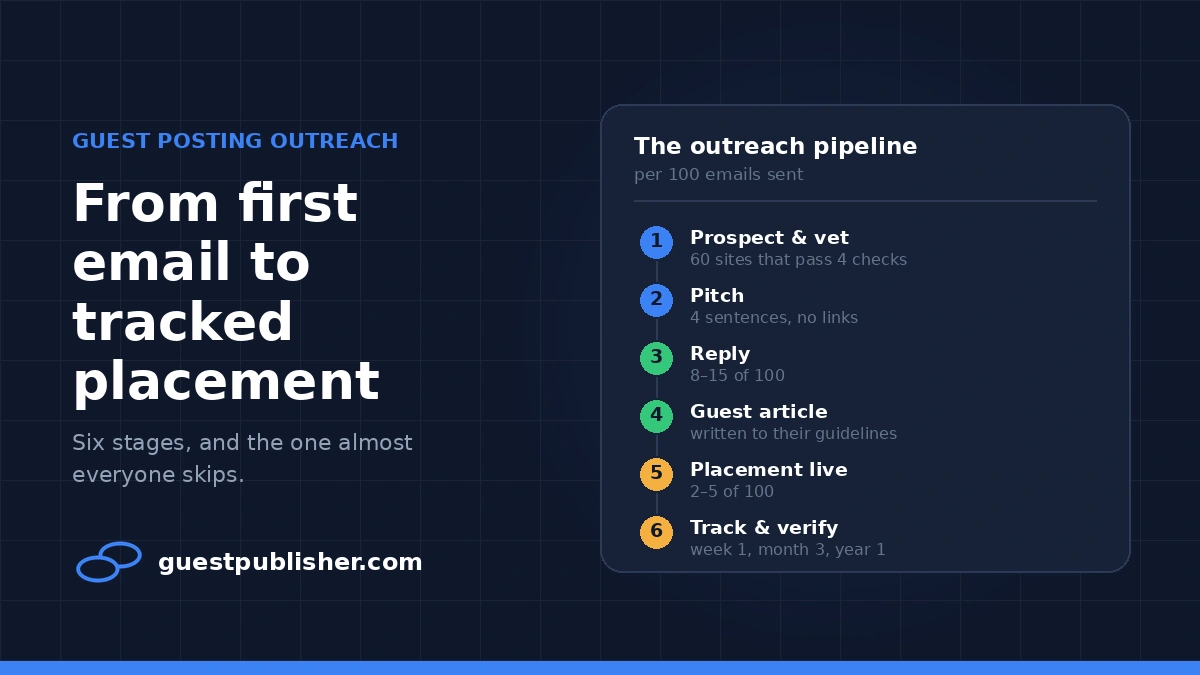
Most people who try guest posting outreach quit in the third week. They send ninety emails, get three replies, and two of those replies ask for money.
That outcome is normal. It is also fixable, because almost everything that decides your results happens before the first email is sent — in how you choose sites, how you write the pitch, and whether anyone measures what happened afterwards.
This is the do-it-yourself version of the process. If you are comparing agencies rather than doing the work, our guide to SEO outreach services covers pricing and what to ask a provider instead.
Everything below assumes you are running it yourself.
What guest posting outreach actually involves
Guest posting outreach means contacting website owners, proposing an article, and publishing it on their site with a link back to yours.
The emailing part is simple. The work that decides your results sits either side of it.
Before the email comes prospecting and vetting — building a list of sites that accept contributions and checking each one has real readers rather than a flattering authority score.
After the reply comes negotiation, writing to the site's guidelines, chasing publication, and confirming the link went live as agreed.
Guest blog outreach done properly spends about a fifth of its time on email. The rest is research and follow-through, which is exactly the part most people skip.
Build the list before you write anything
The most common mistake is choosing targets by Domain Authority alone.
Domain Authority and Domain Rating are third-party estimates built from backlink profiles. A backlink profile can be bought. An audience cannot, which makes traffic the more honest signal.
So when you are hunting for high authority guest posts, check organic traffic first and the authority score second. A site showing DA 55 with 180 monthly organic visitors is not a high DA guest post opportunity — it is a link farm wearing a suit.
Four checks, roughly ten minutes per site:
Organic traffic. Use any traffic estimator. Be cautious below 1,000 monthly organic visits, and suspicious whenever authority is high while traffic sits near zero.
Topical focus. Scroll the last twenty posts. A real publication has a subject. If crypto sits beside wedding dresses beside industrial pumps, you are looking at inventory.
Indexing. Search a recent post title in quotes. If Google does not have it, your article will not be found either.
Outbound links. Open a few articles. Healthy sites link to sources and tools. Sites that link only to commercial pages are telling you what they sell.
Applied consistently, these checks change what a high DA guest post means to you. It stops being a dashboard number and becomes a site with readers — the only version that sends customers as well as ranking signals.
Aim for sixty vetted sites before you send anything. The arithmetic does not work at smaller volume.
One more thing worth knowing about high authority guest posts: the strongest sites are rarely the ones advertising that they accept contributions. They publish outside writers occasionally, through an editor, and they are not on anybody's list of a thousand sites that accept guest posts. Finding them means reading your competitors' backlinks rather than downloading a spreadsheet. If you want a sense of what those placements usually cost before you start, our guest post cost calculator gives you a figure to plan against.
Write a pitch that gets answered
A site owner with a modestly successful blog receives between five and thirty pitches a week. Yours is not competing with silence — it is competing with a stack of near-identical emails.
Almost all of them open with "I came across your website and I love your content." That sentence now reads as proof the sender has read nothing.
What works is short, specific and free of attachments:
One sentence showing you actually read something on the site, referencing a specific post in a way that could not apply to any other post.
One or two sentences proposing a concrete guest article — the working title and what it would cover. Not "I'd like to contribute" but "I could write about X, including Y and Z."
One sentence on why you can write it credibly.
One short question: would that be useful to your readers?
Four sentences is the correct length, not a shortcut. It is also the length that survives being read on a phone.
Leave links out of the first email entirely. Messages containing URLs land in spam far more often, and you gain nothing by including one before anybody has said yes.
Follow up once, four to seven days later, in the same thread. Most positive replies come from that follow-up. Then stop — a third email costs you the relationship, and publishers in a niche talk to each other.
Realistic numbers for guest blog outreach written this way: around 40 percent of emails opened, 8 to 15 percent answered, and 2 to 5 placements agreed per hundred sent. Anyone promising materially better than that either has existing relationships or is not doing outreach at all.
Write the guest article for their readers
Once a site says yes, the article decides whether you are invited back.
An editor can tell within two paragraphs whether a piece exists to inform or to carry a URL. The second kind either gets rejected or published with the link quietly set to nofollow.
Read three of their recent articles before you start. Match their length, their section structure, their technical depth, and whether they use first person. These details are invisible when you get them right and obvious when you get them wrong.
Give the piece one clear argument and support it with specifics — numbers, worked examples, things that could only come from someone who has done the work. Generic advice is what everyone else is pitching.
Then place your link where it genuinely belongs, usually about two-thirds of the way through, at the moment a reader would naturally want more detail. A link in the opening paragraph looks like exactly what it is.
WordPress guest blogging: delivering the draft
Roughly four in ten websites run on WordPress, so WordPress guest blogging is the version you will meet most often.
Some hosts ask for a Google Doc. Others create a contributor account and ask you to draft in their editor. The second is better for you, because you control the headings, the formatting and where the link sits.
A few practical things that prevent arguments. Paste as plain text and rebuild headings in the editor, because formatted text from Word drags in markup that breaks their theme. Use real heading levels instead of bolding lines to fake them. Add alt text to any image you supply. Never touch the Yoast or Rank Math fields unless asked — that is the editor's territory.
If they give you a contributor account, save as draft and tell them it is ready. Publishing yourself, even by accident, ends relationships.
Guest post optimization after publication
Most people treat publication as the finish line. It is closer to halfway, because guest post optimization is what turns a live article into something that keeps working.
Check the link within a week. Open the page, right-click your link, choose Inspect and read the opening tag. A bare `<a href="...">` is dofollow; `rel="nofollow"` or `rel="sponsored"` is not. Some sites publish dofollow and switch it quietly weeks later, so check again at three months.
Share the article from your own channels. A piece with real traffic is more likely to stay published, and the editor notices who brings readers.
Ask the host to link to it from one or two of their existing related posts. Internal links from established pages are the simplest way to boost guest post authority, because a page nothing links to is a page the site itself is not vouching for.
Reply to comments. It costs ten minutes, keeps the page active, and is the main reason editors invite contributors back.
None of these four steps costs money, and together they do more to boost guest post authority than paying for a stronger site would have. A well-supported article on a mid-sized publication regularly outperforms a neglected one on a bigger name.
Guest posting software: what to automate
There is a large market in guest posting software, and it helps with exactly one part of this.
Tools are genuinely good at mechanical work: pulling competitor backlinks into a list, finding contact addresses, verifying those addresses exist, managing sending so you are not pasting into Gmail two hundred times, and flagging replies.
What no tool does well is judgement. Guest posting software cannot tell you whether a site's audience resembles your customers, whether the last twenty posts suggest a real publication, or whether a particular editor will care about your angle.
The failure mode is predictable. Tools make volume cheap, volume makes templates tempting, and templated pitches perform worse than the handwritten ones they replaced. More emails, fewer placements.
Use software for the list and the sending. Keep the choosing and the writing yourself.
How to track guest post placements
If you cannot say what each guest post placement did, you cannot tell good sites from expensive ones — and you will keep buying both.
You do not need a tool. A spreadsheet with ten columns covers it, and you should track guest post placements from the day the first one goes live rather than six months later when the data is already lost.
| Column | Why it matters |
|---|---|
| Site and article URL | The record of what exists |
| Date published | Links need three to six months to show effect |
| Cost | Total, including writing |
| Link type | Dofollow, nofollow or sponsored, as agreed |
| Target page | Which of your pages it points at |
| Anchor text used | So your profile does not skew |
| Last verified live | Check at one week, three months, one year |
| Referral visits | From your analytics, per placement |
| Target page position | Where it ranked before and now |
| Notes | Editor name, response time, revisions |
Three of those columns do most of the work.
Last verified live catches links that vanished. A campaign that appears to have 30 links and actually has 19 live ones is a different campaign, and that gap explains a lot of disappointing results.
Referral visits tells you which niches hold your actual customers. This is usually the most surprising column — the biggest site rarely sends the most useful traffic.
Anchor text used stops you pointing eleven links at one page with the same commercial phrase, which is the fastest way to make a built profile look built.
Review the sheet monthly, and watch impressions in Google Search Console rather than positions, because impressions move first.
Link building with guest posting: the wider plan
Link building with guest posting works best as one strand rather than the whole rope.
A profile built entirely from guest articles looks exactly as manufactured as it is. Real sites accumulate a mix: business directories, industry associations, supplier and partner pages, press mentions, and the occasional link somebody gave them because an article was useful.
A reasonable shape is guest posts carrying about half your deliberate link building, with the rest coming from citations, relationships and content worth citing.
Keep the pace steady. Two or three placements a month sustained for a year beats thirty in one quarter, both in results and in how it looks. If you want to see how a monthly figure divides across authority levels before committing, our backlink budget planner maps it out.
Done this way, link building with guest posting stops being a tactic you repeat until something happens and becomes a programme you can steer, because the spreadsheet tells you which half of it is working.
If you would rather skip the outreach
Honest arithmetic: a hundred carefully researched emails produce two to five placements, and most sites that say yes will mention a fee anyway.
For some campaigns that is still worth it, because relationships built through outreach outlast any transaction. For campaigns under time pressure it rarely is.
The alternative is to start from sites whose metrics are already visible. On our guest post marketplace each listing shows its Domain Authority, Domain Rating, monthly traffic, traffic country and price before you commit, so the vetting in section two is already done for you.
The short version
Choose sites by traffic and topic, not by authority score alone, and vet sixty before you send anything.
Write four-sentence pitches with a specific idea and no links, then follow up exactly once.
Write the guest article for their readers and put your link where a reader would want it.
Check the link at one week and three months, and ask the host to link to it internally.
Track every guest post placement in a spreadsheet from day one, because the column that tells you which sites were worth it is the one nobody fills in until it is too late.