Technology Write for Us: How to Find Tech Blogs That Accept Guest Posts
By Michael Carter
Filed under: Guest Posting
Type technology write for us into Google and you will get thousands of results. Open fifteen of them and you will find that nine are dead pages, three want $400 for a link, and two never reply.
That ratio is normal. It is also why most people give up on this before they place anything.
The pages themselves are not the problem. The problem is that nobody tells you how to read one — which signals mean a real publication, which mean a link farm with a contact form, and what to do once you have a shortlist worth emailing.
This guide covers that. No list of domains that will be stale in six weeks; the method, so you can build your own list any month of the year.
What a "write for us" page actually is
It is a standing invitation. A site that publishes outside contributions puts up a page explaining what it accepts, who to contact, and what the rules are.
Most sites call it one of four things: Write for Us, Contribute, Guest Post Guidelines, or Submit an Article. The wording differs; the purpose does not.
A genuine one tells you specifics — word count, how many links, what topics are off limits, how long review takes. A page that says only "send us your article" and nothing else is usually a form that goes nowhere, or a sales page in disguise.
Reading these pages properly is the whole skill. Everything below is about that.
The searches that actually find them
Plain keyword searches return listicles written by other people. Search operators return the pages themselves.
Paste these into Google and change the topic word to match your niche:
technology "write for us"
technology "contribute to our blog"
technology "guest post guidelines"
technology "submit an article" -jobs
"write for us" + SaaS
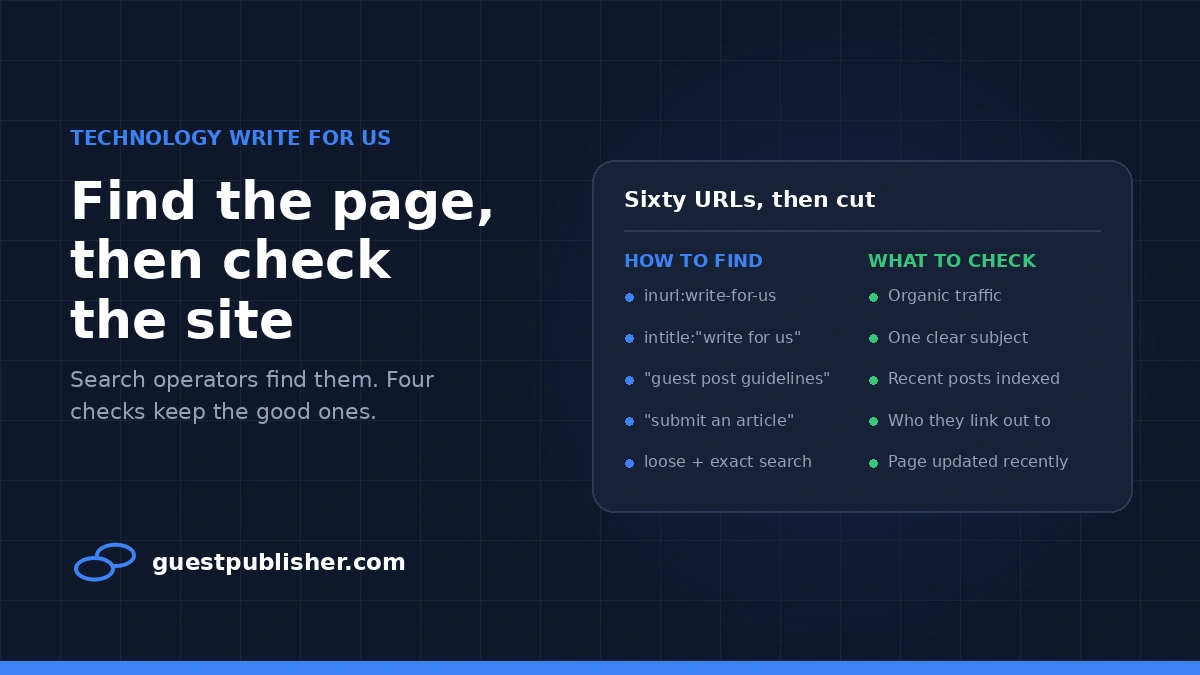
inurl:write-for-us technology
intitle:"write for us" software
The inurl: and intitle: ones are the most productive, because they find the page rather than a mention of it. Many sites shorten the wording, so run tech write for us as a separate search — it surfaces pages the longer phrase misses entirely.
Two refinements worth knowing. Adding -"guest post services" strips out the agencies selling placements. Adding a year rarely helps — most of these pages are undated and the ones carrying a year are often the stalest.
Searching write for us technology without quotation marks gives you a different set again, because Google treats it as a loose phrase rather than an exact one. Run both; the overlap is smaller than you would expect.
Collect sixty to eighty URLs before you start evaluating. The maths does not work at smaller volume — you will lose most of them in the next step.
Why most of what you find is not worth using
Here is where the list shrinks, and it should.
Check organic traffic first. Authority scores can be built; an audience cannot. A site with DA 48 and 150 monthly organic visitors is not a publication — it is inventory. Be cautious under 1,000 monthly organic visits.
Read the last twenty posts. A real tech blog has a subject. If crypto sits beside wedding planning beside industrial pumps, you are looking at a page that will publish anything.
Confirm recent posts are indexed. Search one in quotation marks. If Google does not have it, your article will not be found either, and the link passes nothing.
Look at who they link out to. Healthy sites link to documentation, research and tools. Sites whose every outbound link points at a commercial page are telling you exactly what they sell.
Any two of those failing is enough to drop the site. You will have plenty left, and there is no shortage of tech blogs.
What tech editors want that other editors do not
Technology publications are harder to pitch than most niches, for one reason: their readers can tell when the writer has not done the thing.
A marketing blog will publish a competent overview of a topic. A developer-focused blog will not, because its audience recognises the difference within two paragraphs.
What gets accepted:
Something you actually built, broke, or measured. A migration that went wrong, a benchmark you ran, a config that solved a real problem. Numbers from your own work beat any amount of research.
Code that runs. If your article has a snippet, it must execute. Editors test them, and a broken snippet ends the relationship immediately.
A specific version and date. "This works in Node 20.11, as of October 2026" is worth more than a vague claim, because tech content ages fast and editors know it.
No vendor positioning. The quickest rejection in this niche is an article that reads like a product page with a tutorial bolted on.
A technology blog write for us page will rarely spell this out. It will say "original, high-quality content" and leave you to work out what that means. It means the four things above.
Reading the guidelines properly
Once you find a tech write for us page worth pitching, read it twice before writing anything. Four details decide whether your effort is wasted.
Word count. Writing 2,000 words for a site with a 900-word limit means a rewrite nobody is paying for.
Links allowed. Most allow one or two, usually in the body rather than the author bio. A bio link is worth considerably less than a contextual one.
Link attribute. Few pages state this. Ask before you write, and ask for the answer in writing — some sites publish dofollow and switch it quietly weeks later.
Topics already covered. Search the site for your proposed angle first. Pitching something they published in March is the most common reason good pitches get ignored.
If the page names an editor, write to that person. Generic submission forms have the lowest response rate of any contact method in this business.
One more thing worth checking: whether the technology blog write for us page has been updated recently. A page still asking for submissions by fax, or linking to a Google Form that was closed in 2023, tells you the programme is dormant even though the page is live.
What it costs, and how long it takes
Two honest numbers, because most guides avoid them.
Reply rates. A well-written pitch to a properly researched list gets 8 to 15 percent replies, and 2 to 5 placements per hundred emails. That is a good campaign, not a bad one.
Fees. A large share of sites that say yes will mention a price. Tech placements commonly run $100 to $600 depending on traffic and authority, and the better the publication, the more likely there is a fee.
Neither of those is a failure of your approach. They are what the market looks like. If you want to work out what a given budget buys before you start, our backlink budget planner maps it across authority levels.
For the full outreach process — list building, pitch structure, follow-ups and tracking — our guide to guest posting outreach covers it end to end.
The faster route, honestly compared
Three weeks of searching and emailing to arrive at two or three paid placements on sites you still have to vet yourself is a real cost. Sometimes it is worth it, because a relationship with an editor outlasts any single transaction.
When it is not worth it, the alternative is to start from sites whose numbers are already visible. On our guest post marketplace each listing shows its Domain Authority, Domain Rating, monthly organic traffic, traffic country, link type and price before you commit — so the four checks in section three are already done and shown to you.
Most people doing this seriously use both. Outreach for the handful of publications that genuinely matter in their field, and a marketplace for steady monthly volume.
The short version
A technology write for us page is an invitation, not a guarantee. Treat it as the start of your checking, not the end.
Use search operators rather than listicles, and run both technology "write for us" and the looser write for us technology — they return different sets. Build a list of sixty before you evaluate anything.
Drop any site that fails two of the four checks: traffic, topical focus, indexing, outbound links.
Pitch tech editors with something you measured or built, include a version and a date, and never send a snippet you have not run.
Read the guidelines twice, write to a named person, and ask about the link attribute before you write a word.