What Is a Reciprocal Link? Link Exchanges, Swap Links & SEO Risk
By Michael Carter
Filed under: Guest Posting, Digital Marketing
Someone emails you. They like your blog, they have a site in roughly your industry, and they propose something simple: you link to them, they link to you. Everyone wins.
That is a reciprocal link, and the question of whether to accept is older than Google itself. The answer has changed, though, and most of what is written about it is either twenty years out of date or so vague it tells you nothing.
So here is the direct version. Reciprocal linking is not banned. It is not a penalty waiting to happen. But it is almost certainly the weakest use of the one asset you control on your own site — your outbound links — and at scale it is one of the few link patterns Google names explicitly in its spam policies.
This guide covers what the term means, what the different deals look like in practice, where the real line sits, and what to do when the email arrives.
What is a reciprocal link?
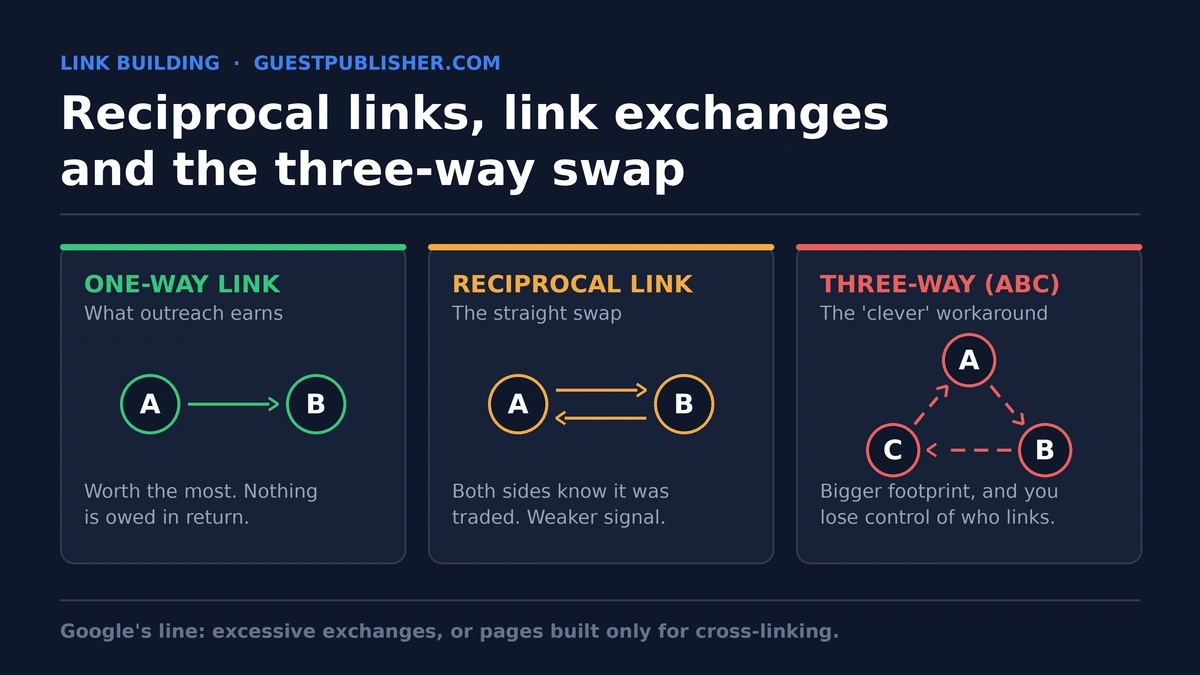
A reciprocal link is a link between two websites that point at each other. Site A links to Site B, and Site B links back to Site A. Two links, two directions, one arrangement.
That is the whole definition. People search for what is reciprocal link, what are reciprocal links and reciprocal link meaning and get long answers to a short question, so to be clear: if two sites link to each other, those are reciprocal links. Nothing more technical is going on.
The word that matters is intent. Two sites can end up linking to each other for completely different reasons:
- By accident. You cited a study on their site in 2024. In 2026 they cited your pricing research. Neither of you knew about the other link. This is ordinary web behaviour and happens constantly.
- By agreement. You emailed each other and agreed to it. This is the exchange of links as a deal, and it is the version this article is really about.
Google cannot read your inbox, so it does not judge a single reciprocal link by your intent. It judges the pattern across your whole link profile. Hold that thought — it explains everything else below.
One more term you will see: a one-way link is a link to you with nothing going back. That is the thing every link building campaign is actually trying to produce, and it is worth more than the reciprocal kind for reasons covered further down.
A reciprocal link example, three ways
Abstract definitions are why this topic stays confusing. Here is a reciprocal link example at each end of the scale.
The natural one. A payroll software company writes a guide to UK employment law and cites a solicitor's firm on one point. The solicitor, writing about payroll compliance a year later, links to the software company's calculator. Two sites, two links, no conversation. Google sees two relevant pages citing each other for good reasons, surrounded by hundreds of other links to and from both sites. This is invisible, and fine.
The negotiated one. Two SEO consultants agree to swap links. Each adds the other to a "recommended partners" block in the footer. Both links sit on every page of both sites, in a block no reader has ever clicked. This is the version that does nothing. The links are sitewide, in boilerplate, with no editorial context — and because each site is the other's only reason for linking out there, the pattern is obvious.
The industrial one. A site joins a group of forty others. Everyone links to everyone, through a "links" page nobody visits. Some of these groups now dress this up as "regular links with reciprocal article" deals — you publish an article containing their link, they publish one containing yours, monthly. This is a link scheme in the plain meaning of the phrase, and it is what the spam policies describe.
The mechanics are identical in all three. The pattern around them is what differs, and the pattern is what gets measured.
How link exchanges actually get proposed
If you run any site that publishes regularly, you already get these emails. Search for link exchanges SEO guidance while one is sitting in your inbox and you will find twenty-year-old advice next to modern spam warnings, which is why nobody is sure what to reply. The emails themselves follow a pattern, and recognising it saves most of the decision.
The opening is flattery with no specifics — "I came across your excellent article" with no mention of which article. Then the offer: they will add your link to a page on their site if you add theirs to yours. Sometimes there is a spreadsheet attached listing the pages available.
Four things are worth checking before you reply to anyone who wants to exchange links.
Where the link would sit. A footer, a sidebar, or a page called "Partners" or "Resources" means a boilerplate placement. A link inside the body of a relevant article is a different proposition entirely. Ask which, and ask for the exact URL.
Whether their outbound page is already a graveyard. Open the page they are offering. If it already holds thirty unrelated links — a casino, a car hire firm, a dentist — you have your answer. You would be the thirty-first.
What their site's traffic looks like. Not its authority score, its organic traffic. A site with a DA of 45 and 200 monthly visitors is not a publication, and a link from it will not send you a reader.
Whether they are asking you to link from a page that matters. Many exchange requests target your highest-authority page, because that is where the value is. If they have picked your best page and are offering you a footer slot, the deal is not symmetrical, whatever the email says.
The honest summary of most link exchanges in SEO is this: you give away an editorial link from a page people read, and you receive a boilerplate link from a page nobody reads. The deal sounds equal because both sides say "one link".
Does reciprocal linking still work, and where is the line?
Most reciprocal linking SEO advice is either "never do it" or "it is fine, relax", and neither matches what Google actually published. The spam policies name this directly. Under link spam, one of the listed practices is:
"Excessive link exchanges ("Link to me and I'll link to you") or partner pages exclusively for the sake of cross-linking"
Two words in that sentence carry all the weight: excessive, and exclusively. Google is not saying that two sites may never link to each other. It is describing a page that exists for no reason other than cross-linking, and a volume of swaps that stops looking like editorial judgement.
The same policy page is blunt about what follows: sites that violate the policies "may rank lower in results or not appear in results at all" (Google Search Central).
So where does that leave seo reciprocal links in practice? Three honest statements:
- A handful of them will not hurt you. If you link to four partners and three of them happen to link back, nothing is wrong. Your profile looks like a normal site's.
- They are worth very little. A link's value comes partly from being an unprompted editorial judgement. When both sides know the link was traded, that signal is weaker — and a link sitting in a footer block passes close to nothing regardless.
- At volume, they become the pattern that gets you caught. The risk is not any single link. It is that forty traded links turn into a recognisable footprint, and footprints are what algorithmic link spam systems are built to find.
The practical test is simple. Would this link exist if you had never spoken to the other site? If yes, publish it. If no, you are buying something with your own site's credibility, and you should be sure the price is right.
It is also worth saying plainly that reciprocal backlinks are not a tactic serious link building programmes use any more. The reason is not fear of a penalty — it is that the return is too low to justify the outbound links you spend.
Three-way exchanges are not the clever workaround
The moment anyone learns that a direct swap looks obvious, the next idea is to hide it. You link to Site B, Site B links to Site C, and Site C links back to you. No two sites point at each other, so there is nothing to detect.
This is sold as an ABC exchange, and the logic has one flaw: the sites in the circle are usually the same sites doing the same deals with each other, over and over. A triangle of three is trivially harder to spot than a pair. A triangle of three hundred, with the same handful of operators behind them, is a network — and a network is a bigger, clearer footprint than the thing it was meant to hide.
There is a second cost that gets ignored. In a direct swap you can at least see what you are getting. In a three-way, you link out to a site chosen by whoever is running the circle, and you have no say in who links to you or from what kind of page. You have handed over the one part of this you controlled.
If you take nothing else from this section: complexity does not make a link scheme safe. It makes it harder for you to audit while leaving the pattern intact.
When a reciprocal link is completely fine
It would be dishonest to end at "avoid it". Plenty of legitimate situations produce two sites linking to each other, and treating those as dangerous would make you behave strangely on your own website.
These are normal and you should not think twice:
- Suppliers, clients and partners. Your payment provider lists you as a case study; you list them on your integrations page. That is business, documented.
- Industry bodies and associations. You link to the trade body you belong to; its member directory links to you.
- Events you speak at or sponsor. Both directions are factual.
- Co-authored or co-published work. A joint report linked from both sites.
- Local listings and genuine directories. A chamber of commerce, a professional register, a council supplier list.
- Citations that happen to go both ways. You cited their data, they later cited yours.
What these share is that the link does a job for the reader. Someone clicking it gets somewhere useful. That is the only durable test, and it is the same test that separates a good outbound link from a bad one in every other context.
If you want to be careful with a commercial arrangement — a sponsor, an affiliate, anything where money or goods changed hands — the answer is not to refuse the link. It is to mark it with rel="sponsored" or rel="nofollow", which Google's own policy names as the acceptable way to handle paid placements. You keep the relationship and remove the ranking question entirely.
How to create a reciprocal link URL properly
If you have decided a link belongs — a real partner, a supplier, an association — then it is worth adding it correctly rather than dropping an anchor in your footer. People searching for how to create reciprocal link url are usually after this part, so here it is step by step.
- Pick the page by relevance, not by authority. The link belongs on the page where a reader would expect to find it. Putting it on your strongest page because it has the most authority is the habit that turns a sensible link into a traded one.
- Write the anchor text as a human would. Use the partner's name, or a plain description of what is on the other end. Do not use their target keyword as the anchor — that single choice is what makes a link look negotiated rather than editorial.
- Use the canonical destination URL. Link to
https://example.com/services/payroll, not to a redirect chain, not to a tracking URL with campaign parameters, and not to thehttp://version. Ask the other site which URL is canonical if you are unsure. - Add the right rel attribute. Nothing for a genuine editorial link.
rel="sponsored"if money or goods were involved.rel="nofollow"if you are simply unsure about the destination.rel="noopener"alongsidetarget="_blank"if you open it in a new tab. - Put it in body copy, in a sentence. A link inside a paragraph that explains why you are pointing there is worth several times a link in a list of logos.
- Record it. Keep a sheet: date, your URL, their URL, anchor text, rel attribute, and who asked. In two years you will not remember, and if you ever audit your outbound links you will need it.
- Re-check it after ninety days. Confirm the link back is still live, still followed, and still on the page you agreed. Links get quietly removed, and attributes get quietly changed.
That last step is the one everybody skips, and it is where most exchange deals fall apart — not dramatically, just silently. If you remember one thing about how to create reciprocal link url entries you will not regret, make it step seven.
What to do with that outbound link instead
Every exchange of links spends something real: a link out from a page you own, on a site you spent years building. Before you trade it, it is worth knowing what the alternatives return.
Earn the link one-way through outreach. Slower, and the only method that produces links nobody can trade away from you. The full process — building a prospect list, pitching, following up, tracking what landed — is covered in our guide to guest posting outreach. If you would rather hand the whole process over, that is what an seo outreach service does.
Place the link in an article on a site that already has readers. This is the straight swap for a traded link: instead of giving away an outbound link, you publish something useful on a site whose traffic you can verify first. Our guest post marketplace shows the Domain Authority, Domain Rating, monthly organic traffic, traffic country, link type and price of every listing before you commit — which is exactly the information a link exchange email never contains.
Work out what your budget actually buys before you spend it. If the appeal of trading links is that it costs nothing, compare it honestly against what paid placement costs at your authority level. Our backlink budget planner maps that out, and our guest post cost calculator prices individual placements.
Compare the providers before you pick one. If you are weighing agencies and marketplaces against each other, our breakdown of the best guest posting services sets out what each model is good for.
None of this means you should never link out. Link out generously — to sources, to tools, to documentation, to competitors when they are right. Outbound links are good for readers and have never been the problem. The problem is specifically the traded outbound link, where the reason for linking is the deal rather than the destination.
Common questions
What is reciprocal link building?
It is acquiring links by offering one of your own in return, rather than by earning them with content, data or outreach. The distinction matters because the currency is different: here you are spending your site's outbound links, which is an asset you can only spend once per page.
What are reciprocal links good for?
Relationships and referral clicks, mostly. If a partner site sends you actual customers, the link is doing a real job regardless of what it does for rankings. Judge them on traffic, not on authority metrics.
Are link exchanges SEO-safe?
A handful, yes — they occur naturally on every normal site. At volume, no. The policy wording targets excessive exchanges and pages built only for cross-linking, and forty traded links is a pattern whatever each individual link looks like.
Is reciprocal linking SEO-friendly in 2026?
Neutral at best. It is not a penalty trigger in small numbers, but it is not a growth tactic either. If your link building plan depends on it, the plan is thin.
Do reciprocal backlinks still pass value?
Some, discounted. A contextual link in a relevant article that happens to be reciprocated still carries weight. A footer or partners-page link carries close to none, reciprocal or not.
How do I swap links without the downside?
Only agree where you would have linked anyway. Put it in body copy on a relevant page, use the partner's name as the anchor, and keep a record. If you would not publish the link without the one coming back, that is your answer.
What are "regular links with reciprocal article" offers?
A standing monthly arrangement: each side publishes an article containing the other's link, repeatedly. It is the industrial end of this practice. The articles exist only to carry links, which is the thing Google's policy describes most directly.
The short version
What is a reciprocal link? Two sites linking to each other. That is all the term means, and the mechanics are the same whether it happened by accident or by agreement.
Google's objection is to excessive link exchanges and to pages that exist exclusively for cross-linking. A few reciprocal links in a normal profile are not a problem.
Reciprocal linking in SEO is low-value rather than dangerous. The link is weaker because both sides know it was traded, and weaker again when it sits in a footer or on a partners page nobody reads.
Three-way and ABC circles do not solve this. They swap a small footprint for a larger one and take away your control over who links to you.
A reciprocal link is completely fine when it does a job for the reader: suppliers, clients, associations, events, co-published work, genuine directories. Money or goods involved? Mark it rel="sponsored" and the question disappears.
Before you agree to exchange links with anyone, check four things: where the link would sit, whether their outbound page is already a graveyard, what their organic traffic is, and whether the two placements are actually equal.
And if the appeal of swapping was that it is free — price the alternative first. A one-way link on a page with real readers is worth more than any number of seo reciprocal links, and you do not pay for it with your own site's credibility.